
The Creative Process as Artistic Material
Making the creation of an artwork visible through the traces of the dialogue between the artist and AI.
FractalPerception establishes a co-creation channel between the artist and AI through the parametric space of fractal artworks.
AI can directly read and generate the parametric files used by the creation software.
This process, explained in Workflow and Co-Creation, produces numerous traces: series of parametric proposals, successive states of the artwork, abandoned branches, and the path leading to the finished work. It also preserves the creative dialogue between the artist and AI: the artist’s choices and directions, and the AI’s proposals, analyses and comments. The work on screen can also be recorded on video to document the entire creative process.
An Observable Co-Creation Process
- The artist always starts from a function in which he identifies a promising parametric space.
- AI can then explore this space at scale and generate series of new proposals.
- The artist observes the results, selects, rejects, transforms and decides on the next direction.
AI explores at scale; the artist directs the exploration.
- The selected forms are then associated with one or more compositions built by the artist.
- Through successive saved states, AI can read the different parametric states of the composition and analyze the transformations that progressively lead to the final artwork.
FractalPerception thus creates an observable co-creation process in which the artwork becomes both the trace and the result of this dialogue.
Making this process visible
An artwork created through this process can be accompanied by all or part of the material produced during its creation.
The public no longer discovers only the final result. It can follow the path that led to it.

The Finished Artwork
The public usually sees only the final image. It embodies the artist’s decisions, but leaves invisible the experiments, variations and choices that led to its finished state.

Successive States
The successive saved states of the composition make its transformations visible. They make it possible to follow additions, removals, returns, bifurcations and directions abandoned during the creative process.
The Forms
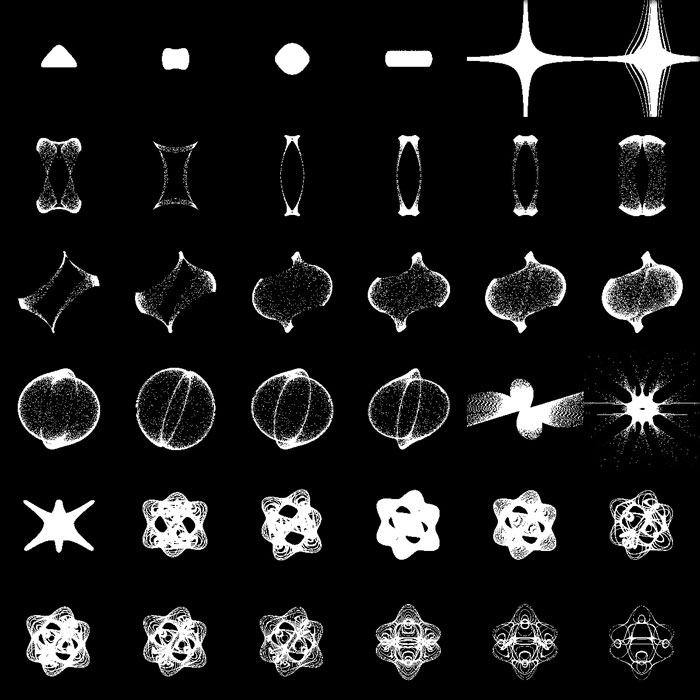
Starting from a function chosen by the artist, AI produces series of parametric forms. The artist observes them, selects one to integrate into the composition or to guide the next exploration, then qualifies the others to help AI understand his choices.
Co-Creation in Action
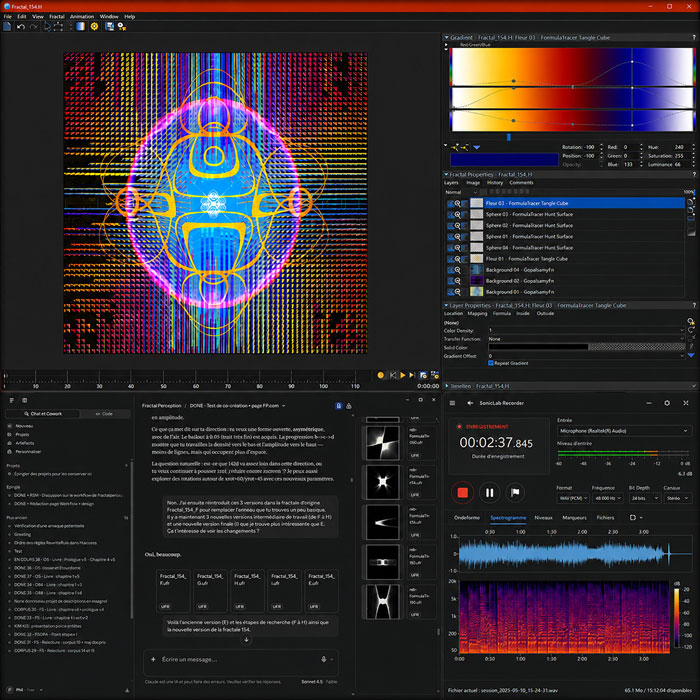
The work on screen and the exchanges with AI can be recorded in parallel. Visitors can thus follow, at the pace of the artwork’s construction, the AI’s proposals, the artist’s choices and the successive directions taken by the dialogue.
The Parametric Double
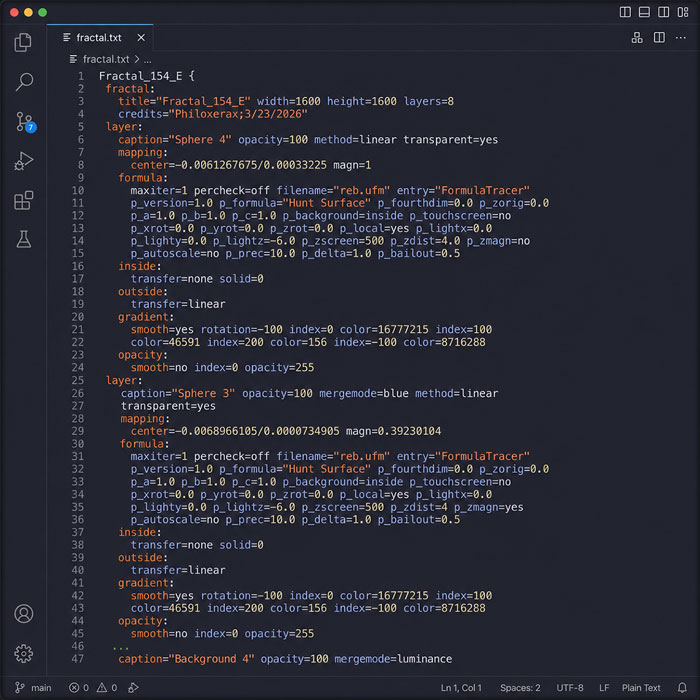
Each image can be presented together with its parametric double: the visual rendering on one side, and the functions, variables and parameters that constitute it on the other. Their mirrored evolution could make it possible to follow the construction of the artwork in both forms.
An Established Corpus
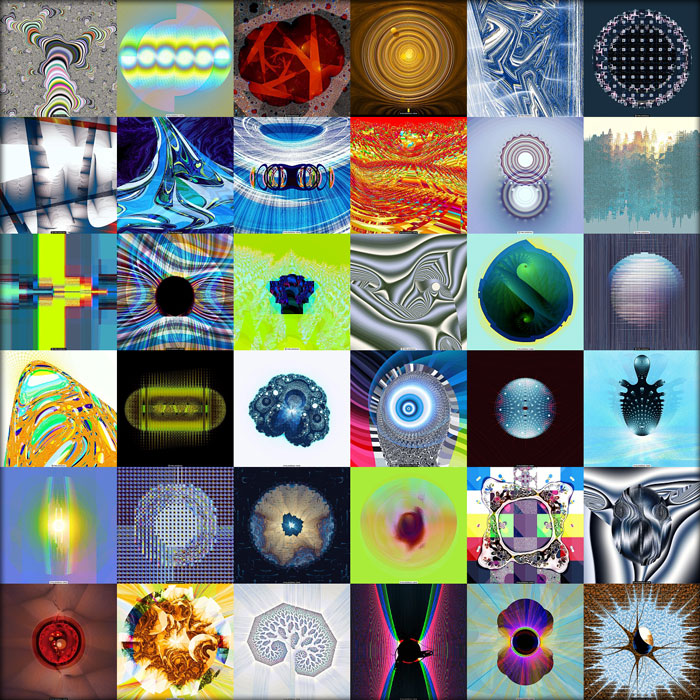
FractalPerception is based on the corpus developed by Philoxerax since 2020: 376 fractal compositions, 1,396 shapes, 116 unique functions and more than 34,000 composition-level parameters. This work constitutes the artistic foundation on which FractalPerception is being built. See more at www.philoxerax.com
Building an Exhibition from the Process
FractalPerception does not currently propose a predefined scenography. It offers an extensive and diverse body of exhibition material documenting a creative process between an artist and AI.
Depending on the project, all or part of this material can be used to develop, with an institution, an exhibition, installation, projection or another form of public presentation.
The aim is not simply to present artworks made with AI.
It is to make the construction of an artwork observable as closely as possible through the dialogue between an artist and AI.
FractalPerception is currently seeking an artistic institution with which to develop this presentation for the public.
In parallel, these same traces are intended to progressively enrich FractalPerception’s research corpus dedicated to aesthetic decisions and the creative process. A first public version of the historical corpus is currently being prepared on Hugging Face.